

We get to the garden and it is superb. A crisp, dry morning the grass is tinted white with frost and perfectly tranquil. We take a few photographs and walk around the large fountain which is set in front of the Palace that now houses the French Senate. We stand and look at the palace for a while, and my friend comments that all these wonderful buildings are tinged with sadness. After all, those that built and lived in them were inevitable wiped out in the revolution. We talk a little about the it but then are distracted by the whooping and laughing of some tourists who are taking photos of each other jumping off the wall in front of the palace. Its sad that they should have come here and found nothing as interesting as jumping off a 2ft wall. 
I exchanged glances with my friend and we walked away. We talked a little more about the precise lay out of the gardens 
Our friend works at the Place de Concorde so we set off toward the river bank. My friend explains to me as we go what she will be doing when she is qualified as an interior designer. We talk about how I would love to live in Paris and write, and we suggest that after my first success I should move their and she would visit me to pick up French antiques. The conversation seemed perfectly sensible at the time, I wondered if it was being in Saint-Germain that made me feel it was possible. Now it sounds like a romantic dream, but I’m not there anymore. We cross the road opposite Les Deux Magots and my friend asks if I wanted to go in, as I had expressed on the train over that I wanted to go here as it was a favourite haunt of Hemingway.
But I come over a little shy, perhaps a little embarrassed to be a literary groupie. Would it really mean so much, sitting somewhere he sat long ago, just because I like the way he writes? I covet his lifestyle, but only the romantic version he portrays through his writing. It was enough I feel to be in Saint-Germain and to wander, as he did and to be inspired. I had my fix.
When I get back home I immediately buy a moveable feast, reading it I can picture the streets, picture the cafes and feel I know a little of what he describes.
In the 1920s Paris’ Saint-Germain-des-Pres Quartre was a literary hot bed of writing exiles. Scott Fitzgerald, James Joyce, Ernst Walsh and Hemingway were part of the “lost Generation” a term coined by the American writer and artist Gertrude Stein. She was describing the thriving artistic community that frequented the cafes and restaurants in the narrow streets between Le Jardin de Luxembourg and the banks of the Seine.
These prolific and admired artists knocked around Paris, drinking, smoking, exchanging views and having illicit affairs in restaurants, cafes, squares and nightclubs. Most of the places are still there, and they would have us believe little has changed since that most exciting and romantic of eras. The Café de Flores, Les Deux Magots and La Closierie des Lilas all proudly swing pictures of Hemingway and Co from their walls. Eager tourists sip chocolat chaud or something a little stronger in an effort to immerse themselves in culture, they sit side-by-side with Parisians sometimes blending in, other times not.
There is a noticeable change in the wealth of the area. Gone are the penniless, idealists – the rents are excessive even in comparison to London and New York. American chains, usually upmarket have taken over a few shop fronts along Boulevard St Germain. But thankfully there is no starbucks sign every 100 yards; no golden arches of McDonalds – but then Paris has not been over run as so many other cities have each becoming cardboard copies of the other.
Even with the events of the last 80 years (occupation in WW2; social uprising in 60s to name but two) and the edging of modernisation, St Germain has retained its unique charm and feel. Walking around the winding cobbled streets, it’s not hard to see why writers and artists flocked here and continue to. The lofty apartment blocks that lean slightly into the streets, the cafes that look like they have been untouched for decades, surely in any other city this would be a novelty. Think Portobello Road in London, which is so crammed with tourists its difficult to move. But there are no gimmicks, a few perhaps geared towards tourists, (One I passed had a sign hanging above the door stating genuine French cuisine was sold inside) the lifestyle that so many covet is still here.
At 10:30 on a Monday morning, there are artists and dealers sipping coffee in the charming mirrored café of La Palette on Rue de Seine. We enter sheepishly, fearful our appalling French will garner us disgust. But the waiter is very accommodating and nods towards an empty table in the back of the room. We mutter ‘deux chocolat et deux crossiant’, he smiles and disappears back to the bar. Two men seated there are engaging in a heated debate, we try not to look over, in our very British way and talk of what we are going to do that day. The hot chocolate is delicious, far less watery than in Britain, there maybe actual chocolate in it rather than just powder. We rip apart our croissants in under a minute and toy with the idea of getting another. If we weren’t meeting our friend in an hour for lunch it would have been completely plausible. The interior is old, with paintings crammed around mirrors. My friend speculates that some artists would pay with paintings if they had no money and we wondered how many of them could have been part of an exchange. We pay and leave; it is only at this point that he discovers we are from London. A sore point for my friend as it wouldn’t have happened if I had not started speaking English - otherwise it would have been a flawless effort on our part.
These prolific and admired artists knocked around Paris, drinking, smoking, exchanging views and having illicit affairs in restaurants, cafes, squares and nightclubs. Most of the places are still there, and they would have us believe little has changed since that most exciting and romantic of eras. The Café de Flores, Les Deux Magots and La Closierie des Lilas all proudly swing pictures of Hemingway and Co from their walls. Eager tourists sip chocolat chaud or something a little stronger in an effort to immerse themselves in culture, they sit side-by-side with Parisians sometimes blending in, other times not.
There is a noticeable change in the wealth of the area. Gone are the penniless, idealists – the rents are excessive even in comparison to London and New York. American chains, usually upmarket have taken over a few shop fronts along Boulevard St Germain. But thankfully there is no starbucks sign every 100 yards; no golden arches of McDonalds – but then Paris has not been over run as so many other cities have each becoming cardboard copies of the other.
Even with the events of the last 80 years (occupation in WW2; social uprising in 60s to name but two) and the edging of modernisation, St Germain has retained its unique charm and feel. Walking around the winding cobbled streets, it’s not hard to see why writers and artists flocked here and continue to. The lofty apartment blocks that lean slightly into the streets, the cafes that look like they have been untouched for decades, surely in any other city this would be a novelty. Think Portobello Road in London, which is so crammed with tourists its difficult to move. But there are no gimmicks, a few perhaps geared towards tourists, (One I passed had a sign hanging above the door stating genuine French cuisine was sold inside) the lifestyle that so many covet is still here.
At 10:30 on a Monday morning, there are artists and dealers sipping coffee in the charming mirrored café of La Palette on Rue de Seine. We enter sheepishly, fearful our appalling French will garner us disgust. But the waiter is very accommodating and nods towards an empty table in the back of the room. We mutter ‘deux chocolat et deux crossiant’, he smiles and disappears back to the bar. Two men seated there are engaging in a heated debate, we try not to look over, in our very British way and talk of what we are going to do that day. The hot chocolate is delicious, far less watery than in Britain, there maybe actual chocolate in it rather than just powder. We rip apart our croissants in under a minute and toy with the idea of getting another. If we weren’t meeting our friend in an hour for lunch it would have been completely plausible. The interior is old, with paintings crammed around mirrors. My friend speculates that some artists would pay with paintings if they had no money and we wondered how many of them could have been part of an exchange. We pay and leave; it is only at this point that he discovers we are from London. A sore point for my friend as it wouldn’t have happened if I had not started speaking English - otherwise it would have been a flawless effort on our part.

Begrudgingly we step out into the freezing street. Rue de Seine is crammed with antique and art shops my friend, a budding interior designer informs me. We linger a little while at the windows before heading toward the Jardin du Luxembourg. There are not excessive sways of tourists, though being December and almost certainly below freezing I suppose that is not a surprise. As we walk we discuss the architecture of the buildings and artistic periods we like and dislike.
 |
We get to the garden and it is superb. A crisp, dry morning the grass is tinted white with frost and perfectly tranquil. We take a few photographs and walk around the large fountain which is set in front of the Palace that now houses the French Senate. We stand and look at the palace for a while, and my friend comments that all these wonderful buildings are tinged with sadness. After all, those that built and lived in them were inevitable wiped out in the revolution. We talk a little about the it but then are distracted by the whooping and laughing of some tourists who are taking photos of each other jumping off the wall in front of the palace. Its sad that they should have come here and found nothing as interesting as jumping off a 2ft wall.

I exchanged glances with my friend and we walked away. We talked a little more about the precise lay out of the gardens

Our friend works at the Place de Concorde so we set off toward the river bank. My friend explains to me as we go what she will be doing when she is qualified as an interior designer. We talk about how I would love to live in Paris and write, and we suggest that after my first success I should move their and she would visit me to pick up French antiques. The conversation seemed perfectly sensible at the time, I wondered if it was being in Saint-Germain that made me feel it was possible. Now it sounds like a romantic dream, but I’m not there anymore. We cross the road opposite Les Deux Magots and my friend asks if I wanted to go in, as I had expressed on the train over that I wanted to go here as it was a favourite haunt of Hemingway.
But I come over a little shy, perhaps a little embarrassed to be a literary groupie. Would it really mean so much, sitting somewhere he sat long ago, just because I like the way he writes? I covet his lifestyle, but only the romantic version he portrays through his writing. It was enough I feel to be in Saint-Germain and to wander, as he did and to be inspired. I had my fix.
When I get back home I immediately buy a moveable feast, reading it I can picture the streets, picture the cafes and feel I know a little of what he describes.
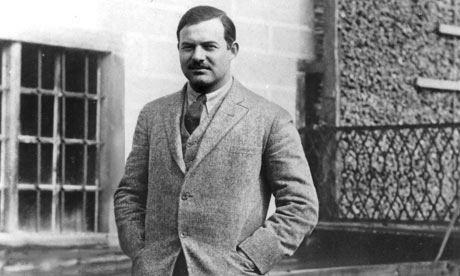 |
| Ernst Hemingway |


No comments:
Post a Comment